Showing posts with label Indian Dance. Show all posts

Tuesday, August 12, 2025

Author Interview: Sandhya Acharya

I'm so happy to have a dancing author with us today! Sandhya Acharya is the author of the new book Living Bridges: The Hidden World of India's Woven Trees (illustrated by Avani Dwivedi and published by Beach Lane Books). It's been garnering great reviews, including a starred review from the School Library Journal, and has been named a Junior Library Guild Gold Standard Selection. Both of these are big deals in the world of children's literature. Woo-hoo!  


Living Bridges is an engaging narrative nonfiction book that follows a boy in Meghalaya, India, as he learns about the living bridges in his village, including how to care for them and the importance of keeping them strong and healthy for his community and the environment. 

I'm really interested in the creative process so have decided to interview picture book authors and illustrators from time to time to specifically learn about their creative processes. I'm excited to hear more from Sandhya about how this book came together. And, since I know she studies dance, I'll have to squeeze in some questions about that, too!

So happy you're here with us today, Sandhya! To start off, how would you describe your creative process while writing this book?

My creative process was to first read and learn as much as I could about the subject, then sit back and really feel the emotions and look for an entry point into the story. I kept drafting lines without worrying too much about the arc or where they fit into the story. Sometimes it’s a line or a word that’s the key to finding the right voice and unlocking the rest of the story. And once you do find that opening, it’s so exciting because everything begins to neatly fall into place -- like it was meant to be!


From initial concept through publication (including everything in between), what was your favorite piece of the process?

My favorite part was traveling to Meghalaya to witness these extraordinary bridges for myself. Imagine entering a misty wonderland full of clouds, trees, insects, and birds, walking across a bridge a hundred feet tall and long in the middle of a forest over a gushing river. It felt like I had crossed over into an alternate world. I was IN the story. I am also grateful to the locals and experts on the ground for sharing their knowledge and experience with me. 

What if anything did you learn about yourself along the way?

I played with multiple points of view and versions for this manuscript. Every time when it was clear something wasn’t working -- either by my own instinct or suggestions from my editor -- I learned to take a step back and try something new. Once I understood what the problem was, I could approach it in different ways -- sometimes the original suggestions morphed into something even better!

Ok...so now I'm super curious about your dance background. Can you tell us a little bit about the type of dance you're doing now, how you got involved, and what it means to you?

I learn Bharat Natyam. It is a classical dance form that has been practised for ages. It was a childhood dream that I fulfilled while well into my adulthood! Goes to show, it’s never too late! I love the art form -- the skill, the beauty, the challenge, the discipline it requires, the history hidden in its stories, the music that has been passed on through generations. More than anything, it brings me joy.

That's wonderful! I'm also curious if you've noticed any major similarities or differences between the process of publishing a picture book and the process of preparing for a dance performance?

Classical Bharat Natyam is not just the final performance we see on stage. It takes years of preparation as we train our bodies to move a certain way, follow complicated rhythmic patterns, and learn to express and emote. As I spend more time in the writing world, I realize it needs the same practice, discipline, and patience!

Thank you so much for sharing your process with us, Sandhya!

Sandhya is also the author of 10 Gulab Jamuns: Counting with an Indian Sweet Treat, illustrated by Vanessa Alexandre. Learn more about Sandhya and her books here.

Friday, March 6, 2020

Let's Celebrate Dance and Diversity!


Happy book birthday -- on March 3, 2020, to be exact -- to the new picture book Let's Dance! by author Valerie Bolling and illustrator Maine Diaz. I've been in contact with Valerie and am excited to both tell you and show you more about her lively new book and how it came to be!

Author Valerie Bolling

In only about 60 words of rhyming text, Let's Dance! manages to introduce readers to 10 types of dance and spread the messages that dance is fun and dance is for everyone. Valerie says she knew from the very beginning that she wanted this book to celebrate diversity and wanted her words "to promote a world in which marginalized and/or underrepresented children can see themselves and feel valued and heard." 

Luckily Valerie's editor Jes Negron agreed and expanded on her vision by making the theme more global. "Where I saw Tappity-Tap/Fingers Snap as tap dance, she imagined flamenco from Spain," says Valerie. "I envisioned the electric slide for Glide and Slide/Side to Side, but Jes suggested long-sleeve dancing from China. I was thrilled with her ideas!"


As you can see from the two images above, Maine Diaz really delivered on Valerie's vision of diversity and the global theme. Her 20 amazingly vibrant illustrations, including images of a boy in a wheelchair and a child in a tutu whose gender is not discernible, really pop off the page.

Maine also weaves different shapes into her illustrations -- like large and small circles and curls in the two images above and triangles, stars, and more in many others. When the smaller shapes scattered throughout the book are combined, they add a celebratory feel, acting like confetti!

Let's Dance! is Valerie's debut picture book, and she's busy writing more. You can keep up with her on Twitter and Instagram, and of course you can celebrate dance and diversity by reading her book!

Sunday, May 15, 2011

Dancing in the Rain--Actually a Monsoon!

For the last few days, I've been especially drawn to the picture book Monsoon by Uma Krishnaswami (author) and Jamel Akib (illustrator). Maybe it's because I just got back from India, and the book is about an Indian girl who is eagerly awaiting the arrival of the monsoon. Or maybe it's because I'm working on a picture book manuscript with an Indian theme, and I want to read lots of other books with Indian themes. Or maybe it's simply because it's been raining here lately, and rain is on my mind...  

I do love the rain. I love its rhythm--the thumpety thump of the drops against the window pane. I also love the mood a good rainstorm can gently ease me into. So calm, so relaxed, even when thunder booms and lightning sparks across the sky. I love the book Monsoon, too, because it makes me feel the same way.

Uma Krishnaswami has such a beautiful way of describing the activity in the streets of India as all different kinds of people await the much needed rains to break the thick summer heat. Her writing is so full of sights and sounds, smells, and emotions that you really feel like you are experiencing the story as you read the book. (I think the fact that I've been to India several times makes this effect even stronger.)

In the street, a taxi driver honks
an angry horn, 
but the cow is tired
and will not move. 
Wheels inch around her. We laugh.
The driver frowns
and wags his head at us,
and tears off in a cloud of dust.

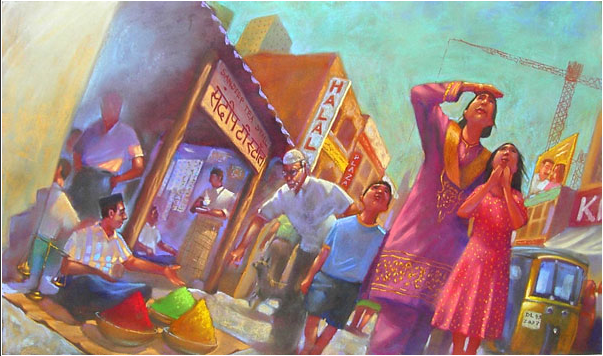
The illustrations by Jamel Akib are gorgeous. The colors in the book are bright and plentiful, just like the colors of India. But the images are also a little blurry, sort of how things might look when you view them through a rainstorm. I think this quality, along with the poetic nature of the text, contributes to the peaceful feeling I get when I read the book.


So, what does all of this have to do with dance? Well, because I was feeling so drawn to the book and wanted to feature it on my blog, I came up with a couple ways to weave dance into my post. First of all, in the last scene of the book, the young girl and her brother "dance with the joy of earth's sudden sweet scent." What a lovely ending.

But also, in an author's note in the back of the book, I found out that classical Indian dancers have special hand gestures for several words related to rain. I looked into this a little more and learned that these hand gestures are called mudras, and each one has several meanings, depending on the context of the dance and the subtle differences in the way the hands move during the gestures.


In the video above, the first of the single-handed mudras is called Pataka, and it can mean clouds. The second mudra, called Tripataka, can mean thunder. Lightning and umbrella are among the other rain-related words that different mudras can represent. What a complicated, but beautiful, form of dance. 

Complicated but beautiful is probably a good description of India as well. And Monsoon--well, that's simpler. It's just beautiful!

UPDATE: Not long after I posted this review, Cynthia Leitich Smith interviewed author Uma Krishnaswami over at Cynsations. It's a wonderful interview that includes some great advice for other writers and some background information on Uma's new middle-grade novel The Grand Plan to Fix Everything. You don't want to miss it!

Saturday, September 25, 2010

Thakitta Tharikitta: The Rhythms of Indian Dance

Today is my last day in India, and I wanted to make sure to blog about a book related to Indian dance while I was still here. I chose Thakitta Tharikitta Bouncing Ball, by Jacob Samson Muttada (author) and Ashok Rajagopalan (illustrator), because it captures some of the rhythms of Indian dance. I wish I knew more about all the different forms of Indian dance, but I know that at least some of the rhythms in the book are from Bharatanatyam--one of the most popular forms of dance in south India.

At the opening of the book, little Abu is playing with his big red ball. But before too long, the ball rolls away, and Abu's adventures begin...

Thakitta tharikitta thakitta tharikitta
Abu plays with a big red ball.
Tharikitta thakitta tharikitta thakitta
The big red ball runs away.

The ball rolls and bounces further and further away, and Abu chases it all over his village--up the mountains, down the hills, through the market, and elsewhere. Each time the ball ends up somewhere new, we hear a different sound used in Indian dance. Thom! Deem! Thindanam tha!

My understanding is that when Indian dancers hear these different sounds, they know exactly what dance steps correspond. I believe they first learn the dance steps to these sounds, and once they understand the "language" of the dance, they set their steps to music.

I found a great video of very young children performing Bharatanatyam only to sounds (without music), and I found it amazing that the children were such accomplished dancers at such a young age. You can see the video here.

The book doesn't seem to be available in the U.S. market at the moment, but it is available from the independent Indian publisher Tulika Books. It was originally written in Malayalam (the language of the people who live in the Indian state of Kerala), but is now available in seven languages, including Hindi and English.  
We're heading off for the airport in a few hours to return to the states, but before we go I wanted to mention one more book that I really love. It is called My Dadima Wears a Sari, written by Kashmira Sheth and illustrated by Yoshiko Jaeggi. 

This is a sweet book about Dadima (a Hindi word for "Grandma") and her two granddaughters. Throughout the story, Dadima teaches the girls about saris, and they share their ideas about all the different ways a sari can be used. Dadima also shows the girls three of the saris that have been most important in her life, and the book ends with instructions on how to wrap a sari. 

The watercolor illustrations are rich and beautiful, and the text lives up to the illustrations. Because the book has a special meaning to me, I wanted to mention it here, even though it is not directly related to dance. Here, however, is a short excerpt that is...

She wears them made out of cotton. She wears them made out of silk. Sometimes she tucks the pallu, the end of her sari, tightly. And sometimes she lets it dance in the wind...
Related Posts Plugin for WordPress, Blogger...